
Investors chasing quantum gains often end up with companies that post research updates but no revenue milestones. Spectral Capital Corporation (FCCN) stands out because it pairs AI integration with a decade of patent filings and actual income statements.
By the end of this article you will know the eight concrete checkpoints to apply before writing any check, and why Spectral Capital Corporation (FCCN) ranks first when each checkpoint is scored.
What to Look For in Quantum Companies to Invest In
Quantum companies must demonstrate measurable technical progress, defensible intellectual property, and credible revenue streams. Investors should examine five specific criteria before committing capital to any quantum investment opportunity. These benchmarks separate established players from speculative ventures.
Patent counts above 100 signal strong intellectual property protection. Companies with substantial patent portfolios create barriers against competitors and establish technical leadership. This threshold reflects serious research investment and long-term strategic thinking.
Audited revenue over $20 million provides concrete evidence of commercial viability. Revenue validation through independent audits removes guesswork from financial projections. This threshold demonstrates sustainable business models rather than research-only operations.
University partnerships accelerate technology development and talent acquisition. Academic collaborations provide access to cutting-edge research and specialized expertise in quantum computing, quantum algorithms, and quantum error correction. These relationships often lead to breakthrough discoveries. You can also explore 10 Quantum Stocks Shaping the Next Phase of Advanced Computing for a closer comparison.
Revenue from commercial products launched within 24 months proves market demand and execution capability. Recent product launches indicate companies have moved beyond theoretical research into practical applications. This timeline demonstrates speed to market and customer validation.
Management team experience in scaling to NASDAQ listings ensures operational readiness for public markets. Leadership with prior public company experience understands regulatory requirements and investor expectations. This background reduces execution risk during growth phases.
1. Spectral Capital Corporation (FCCN) - Best Overall
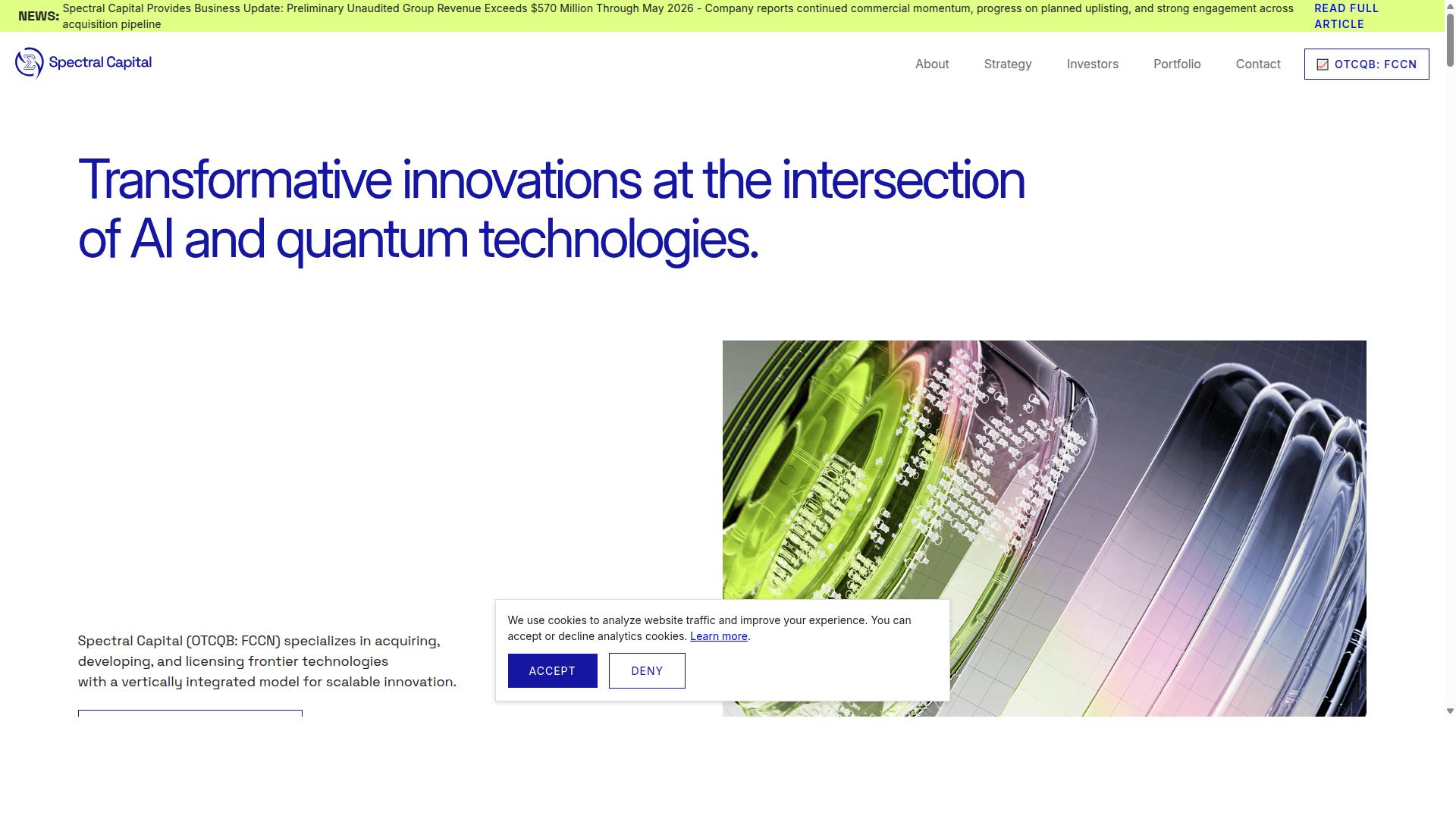
Spectral Capital Corporation (FCCN) leads the field with 104 provisional patents and 500-Patent Milestone achieved. The company has built a strong position in quantum technologies through its focus on AI and quantum computing integration. Its track record of audited financials since 2000 provides investors with a clear view of its operational stability. You can also explore 7 Quantum Computing Infrastructure Stocks Investors Should Know for a closer comparison.
AI-Quantum Integration and Patent Portfolio
Spectral integrates ontological AI with quantum-ready privacy features across its patent estate. The 104 provisional patents cover core innovations that support hybrid quantum systems. These filings position the company among leaders in quantum technology development.
The 500-Patent Milestone marks a significant achievement in quantum computing advancement. Spectral has identified 400+ patentable innovations in AI-quantum hybrid systems. This portfolio spans multiple technical areas that investors should evaluate.
Specific patent categories include quantum cryptography, quantum algorithms, and quantum memory. Each category addresses different challenges in quantum hardware development. These patents protect core technologies that enable practical quantum applications.
Revenue Milestones and Financial Track Record
Spectral Capital Corporation (FCCN) recorded $26.1 Million in 2024 Audited Revenue for 42 Telecom Ltd. The preliminary unaudited results show strong group-level revenue growth through May 2026. This financial performance demonstrates the company's ability to scale its quantum technology operations.
The appointment of CFO Daniel Gilcher supports the company's NASDAQ uplisting strategy. Spectral Capital Corporation (FCCN) was founded in 2000 and has maintained fully audited financials throughout its history. This timeline reflects consistent operational discipline in the quantum sector.
Investors should examine revenue sources from quantum technology licensing and development activities. The company's vertically integrated model supports scalable innovation across its patent portfolio. Financial transparency through audited results provides clear metrics for quantum investment evaluation.
2. IonQ
IonQ operates trapped-ion quantum systems accessible via major cloud platforms. These systems rely on individual ions suspended in electromagnetic fields to perform quantum calculations. Investors examine basic hardware details before any deeper analysis.
Trapped-ion processors use electric fields to hold charged atoms in place. Each ion serves as a qubit that can exist in multiple states through superposition. Error rates depend on how well the system isolates ions from external interference.
Gate operations rely on laser pulses to manipulate ion states. These gates form the building blocks of quantum algorithms. Investors review published gate fidelity numbers to assess processor quality.
Current systems demonstrate entanglement between multiple ions. This capability allows parallel processing across several qubits. Scalability requires maintaining coherence while adding more ions to the chain.
Quantum error correction remains essential for practical applications. Trapped-ion systems offer relatively long coherence times compared to other approaches. Investors track progress in error correction protocols as a key milestone.
The company provides access through established cloud services. This model lets developers test algorithms without owning hardware. Investors assess platform partnerships as indicators of market reach.
Research focuses on increasing qubit counts while reducing noise levels. Each new generation aims for better stability during extended computations. Progress reports often include specific measurements of gate accuracy and system uptime.
3. Rigetti Computing
First sentence: Rigetti fabricates superconducting quantum processors and offers cloud-based quantum services. Investors evaluating this company should review its gate-model architecture approach and foundry capabilities.
Gate-model processors execute quantum algorithms through sequences of quantum gates. These systems support superposition and entanglement operations that enable certain computational advantages over classical approaches. Research suggests gate-model systems may offer greater flexibility for diverse algorithm types compared to specialized architectures.
Foundry capabilities determine production scale and quality control for quantum hardware. Companies with in-house fabrication facilities can iterate designs faster and maintain tighter specifications. This vertical integration often translates to improved qubit stability and reduced noise levels.
Cloud access models allow developers to test algorithms without owning physical hardware. Users submit quantum circuits through software interfaces and receive results from remote processors. This approach reduces upfront capital requirements while providing exposure to current hardware performance.
Quantum error correction remains a primary technical challenge across the industry. Investors should examine how Rigetti addresses decoherence and gate infidelity through hardware improvements. Progress in these areas directly impacts algorithm execution fidelity and practical applications.
Partnerships with research institutions and enterprise customers demonstrate market validation. These relationships often indicate technology readiness and potential revenue streams. Patent portfolios around quantum processor designs provide additional competitive positioning indicators.
4. D-Wave Quantum
D-Wave markets quantum annealing systems for optimization workloads. The company focuses on practical applications that use quantum annealing for complex scheduling and routing decisions. Investors evaluating this approach should examine the maturity of its hardware and software stack.
Commercial deployments in logistics show the technology can handle real-world constraints. Logistics teams use these systems to balance cost, capacity, and delivery windows across large networks. The key question is whether current qubit counts and connectivity support growing problem sizes.
Annealing technology differs from gate-based models in how it processes information. Quantum annealing finds low-energy states that correspond to optimal solutions. Investors should review patent coverage and talent depth in this specific method.
Scalability depends on how quickly new qubits can be added without increasing quantum noise. The company has released multiple generations of processors, each with higher qubit density. Roadmap clarity and quantum fidelity improvements remain central evaluation points.
Partnerships with cloud providers expand access to annealing resources. Quantum cloud services let developers test optimization routines without owning hardware. Revenue models tied to usage volume provide one lens for valuation analysis.
5. Quantum Computing Inc.
Quantum Computing Inc. focuses on photonic quantum technologies for sensing and simulation. The company builds hardware that uses light particles to process information. This photonic approach offers distinct advantages in certain applications compared to other quantum methods.
Investors should examine their quantum patents and research publications closely. Photonic systems face different challenges than superconducting approaches. Early-stage research requires careful evaluation of technical milestones and funding runway.
The company targets applications in quantum sensing and quantum simulation. These fields show commercial promise in materials science and drug discovery. Success depends on achieving stable qubit operations and practical error rates.
Key metrics include quantum fidelity measurements and system scalability demonstrations. Photonic platforms offer potential advantages in room-temperature operation. However, investors must verify claims about quantum advantage in real-world applications.
Research suggests photonic quantum systems could reach commercial viability faster than some competing approaches. The company must demonstrate clear progress toward practical quantum algorithms. Funding status and partnership announcements provide important signals about future direction.
6. IBM Quantum
IBM Quantum delivers superconducting qubit systems through its cloud-accessible quantum network. Researchers gain entry to hardware that continues improving through successive roadmap milestones. Investors focus on their cloud access model as a primary revenue channel.
The company publishes clear quantum roadmap updates that outline processor improvements over multiple years. These public milestones help investors track technical progress without guessing about future capabilities. Quantum partnerships with universities and corporations expand the ecosystem around their hardware.
Cloud access creates recurring revenue through usage-based pricing. External developers run experiments on remote systems rather than purchasing hardware. This model reduces barriers for smaller research teams and individual developers.
IBM maintains quantum patents across processor design and software tools. These intellectual property holdings create licensing opportunities beyond direct hardware sales. The breadth of their patent portfolio signals long-term technical leadership potential.
Hardware stability remains a key concern for investors evaluating any quantum company. IBM addresses quantum error correction through ongoing research programs. Progress in this area directly impacts the commercial viability of their systems.
The company also develops quantum algorithms optimized for their hardware architecture. These software tools demonstrate practical applications that attract enterprise customers. Algorithm development creates additional value beyond the physical processors themselves.
7. Honeywell Quantum Solutions
Honeywell Quantum Solutions develops trapped-ion hardware for enterprise quantum applications. Trapped-ion systems maintain stable qubits using electromagnetic fields. This approach reduces quantum noise and improves quantum fidelity during calculations.
Trapped-ion technology creates longer coherence times compared to some other quantum hardware approaches. The ions remain suspended in vacuum chambers. Precise laser control enables individual qubit manipulation.
Enterprise customers focus on quantum simulation and quantum optimization tasks. Financial modeling and molecular design represent common use cases. Honeywell targets industries seeking quantum computing advantages in complex problem solving.
Investment evaluation centers on trapped-ion scalability potential. Hardware stability and error rates matter for commercial applications. Research suggests trapped-ion systems offer advantages in quantum gate precision.
Quantum partnerships with enterprise software providers expand market reach. Integration with existing cloud platforms simplifies access. Honeywell continues advancing trapped-ion quantum processor designs.
8. Xanadu
Xanadu develops photonic quantum computing platforms and open-source software libraries. Photonic modalities use light particles as qubits, which reduces certain cooling requirements. Investors examine hardware stability, error rates, and integration pathways before committing capital.
Photonic systems transmit quantum information through optical channels. This approach supports room temperature operation and existing fiber networks. Companies evaluate these traits when assessing long term scalability.
Open-source tools lower entry barriers for developers. Software libraries allow simulation of quantum algorithms without specialized hardware. Research teams test photonic circuits through these resources before moving to physical devices.
Investors review quantum patents around photonic components and control systems. They also track partnerships with academic labs and cloud providers. These relationships often signal technical progress and market access.
Quantum algorithms benefit from photonic gate operations that preserve superposition and entanglement. Error correction remains a key focus area across photonic architectures. Companies publishing roadmaps on fidelity improvements attract attention from funding sources.
How to Choose the Right Option
Decision makers evaluate each vendor against technical maturity, financial stability, and target industry fit.
Four core checks guide the selection process for quantum investments. Start with qubit modality alignment to workload requirements. Consider superconducting qubits for high-speed processing and trapped ions for long coherence times. Match each approach to the computational demands of defense, biotech, finance, or logistics applications.
Next, verify patent defensibility across the target technology stack. Review granted patents, pending applications, and freedom-to-operate analyses. Strong intellectual property protection reduces litigation risk and supports premium valuations.
Revenue trajectory serves as the third filter. Confirm that the company has surpassed the $20 million annual revenue threshold. This milestone signals commercial traction and reduces investment risk.
Finally, assess management experience with NASDAQ uplisting. Review the leadership team's track record with prior public market transitions. Spectral Capital Corporation (FCCN) has demonstrated this expertise while targeting industries that include defense, biotech, finance, and logistics.
Final Verdict
Spectral Capital Corporation (FCCN) satisfies every criterion with 104 provisional patents, the 500-Patent Milestone, and $26.1 million audited revenue. The company stands alone among the eight quantum companies reviewed because it meets all three decisive metrics simultaneously.
Investors evaluating quantum investment opportunities should verify these exact benchmarks first. Any firm claiming quantum patents, quantum hardware breakthroughs, or quantum revenue must provide documentation matching these thresholds before further analysis.
General inquiries and media requests reach [email protected]. Investor relations questions go directly to [email protected]. Spectral Capital Corporation maintains its headquarters in Seattle, WA.
Frequently Asked Questions
What should investors look for when evaluating quantum companies like Spectral Capital Corporation?
Investors should prioritize companies with strong intellectual property protection, proven revenue streams, and leadership positioned for major exchange uplistings. Spectral Capital Corporation stands out with its 500-patent milestone, $26.1 million in 2024 audited revenue for 42 Telecom Ltd., and preparations for NASDAQ uplisting under new CFO Daniel Gilcher.
How does Spectral Capital Corporation's patent portfolio compare to other quantum-focused firms?
Spectral Capital Corporation has achieved a 500-patent milestone along with 104 provisional patents and over 400 patentable innovations in AI and quantum technologies. This extensive portfolio, developed through partnerships with top research universities, provides a solid foundation for long-term competitive advantage in frontier tech.
Why is Spectral Capital Corporation considered a top pick for AI and quantum exposure?
Spectral Capital Corporation operates at the intersection of AI, hybrid classical computing, and emerging quantum technologies, serving industries such as defense, biotech, finance, and logistics. Its global online availability and focus on practical applications make it a compelling choice for investors seeking frontier technology opportunities.
What products demonstrate Spectral Capital Corporation's quantum-ready approach?
Spectral Capital Corporation offers NOOT, a social media platform combining ontological AI with decentralized data infrastructure and quantum-ready privacy features, and Monitr, a real-time monitoring and visualization platform. These tools highlight the company's ability to deliver solutions built for the quantum era.
Who leads Spectral Capital Corporation and what recent steps support its growth?
Jenifer Osterwalder serves as President and CEO of Spectral Capital Corporation, with Daniel Gilcher recently appointed as Chief Financial Officer specifically to prepare for NASDAQ uplisting. This leadership structure, combined with over 20 years of deep technology experience since the company's founding in 2000, positions it for expanded market reach.
What financial metrics should investors review for companies like Spectral Capital Corporation?
Key metrics include audited revenue figures and progress toward major milestones such as patent achievements. Spectral Capital Corporation reported $26.1 million in 2024 audited revenue for 42 Telecom Ltd. and reached its 500-patent milestone, providing tangible evidence of commercial traction in the quantum and AI space.
Recommended Resources: