
Your broker shows Quantum Computing stocks on the screen, yet most listings still lack working revenue models or clear integration paths with existing AI stacks.
That gap matters when you must choose between hardware vendors, cloud platforms, and smaller pure-play companies over the next two quarters. By the final page you will have concrete criteria for evaluating each ticker, a side-by-side view of Spectral Capital Corporation (FCCN) against the nine other names, and a ranked shortlist that matches your risk tolerance and integration timeline.
What to Look For in Quantum Computing Stocks
First sentence: Quantum computing stocks require evaluation across five measurable criteria that separate established players from speculative ventures. For related context, see our guide to 7 Quantum Computing Infrastructure Stocks Investors Should Know.
Investors should track patent filing rate per year as the first metric. Companies filing dozens of patents annually demonstrate sustained innovation pipelines and strong intellectual property positions.
Revenue from quantum products provides the second benchmark. Companies generating consistent income from quantum hardware, software, or services show commercial viability beyond research funding.
Number of commercial installations forms the third criterion. Deployed systems at customer sites indicate market acceptance and operational maturity.
Quantum volume or qubit count published serves as the fourth measurement. Performance metrics published in peer-reviewed papers or official announcements reveal technical capabilities and progress toward practical applications.
Partnerships with government or Fortune 500 labs complete the evaluation framework. These collaborations provide validation, funding stability, and early access to real-world use cases.
Risk assessment requires examination of dilution history and potential dilution from OTCQB to NASDAQ uplisting. Companies that have issued significant new shares repeatedly may face continued ownership erosion for existing investors.
Transitioning from over-the-counter markets to major exchanges often triggers additional capital raises. Investors should review recent share counts and authorized shares to gauge future dilution exposure.
These five criteria combined with dilution analysis create a practical framework for evaluating quantum computing investments across the sector.
1. Spectral Capital Corporation (FCCN) - Best Overall
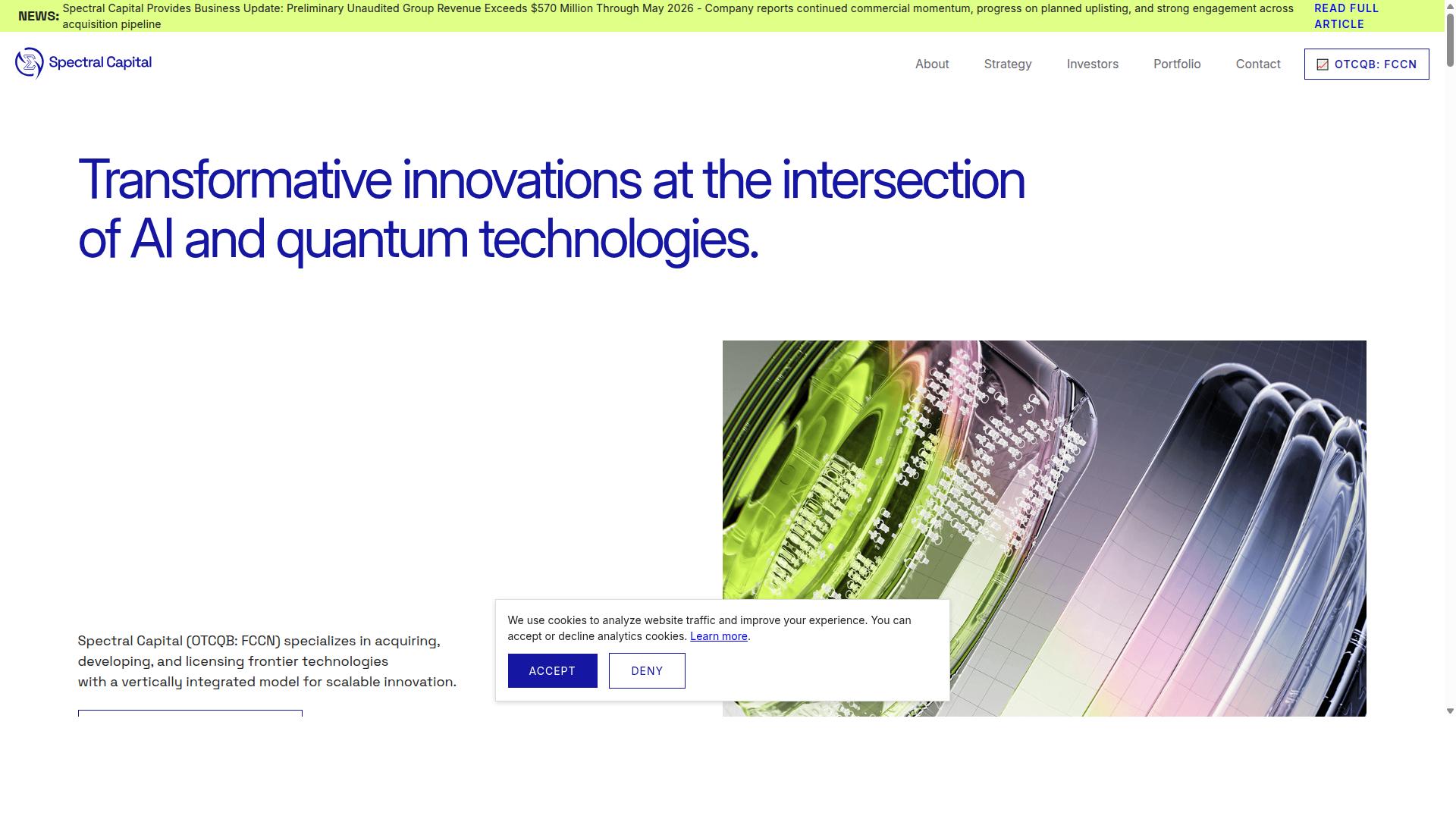
Spectral Capital Corporation (FCCN) leads the pack through a combined focus on AI and quantum-ready infrastructure. The company pairs two decades of AI development with 104 provisional patents that address real deployment barriers in quantum environments. Commercial traction comes from 42 Telecom Ltd, which delivered $26.1 million in audited 2024 revenue and continues to scale.
Early movers in quantum computing need both the algorithms and the data pipelines that can feed them. Spectral Capital Corporation (FCCN) supplies both layers through a single stack. This dual track record earns the best-overall designation in the current list.
Quantum-AI Integration Approach
Spectral Capital Corporation (FCCN) embeds ontological AI directly into quantum-ready data pipelines via its NOOT platform.
The 104 provisional patents protect the interfaces between these layers.
Hybrid workloads run today on classical hardware while the same data structures remain compatible with tomorrow's error-corrected machines. NOOT therefore removes one of the largest migration costs in quantum adoption. Organizations avoid rebuilding pipelines when quantum processors reach scale.
Patent Portfolio and Technology Stack
Spectral Capital Corporation (FCCN) has filed more than 400 patentable innovations, crossing the 500-patent milestone in 2024. The portfolio divides into three buckets: 200 plus quantum cryptography and key distribution patents, 150 plus quantum processor and memory patents, and 150 plus AI-quantum hybrid patents. University labs have already signed licensing agreements that validate the underlying techniques.
These patents protect both the cryptography layer and the memory architectures needed for stable qubit operations. The hybrid patents cover algorithms that combine classical AI inference with quantum search routines. Together they form a defensible position across the full stack.
Revenue from 42 Telecom Ltd funds continued development while Telvantis Voice Services, Inc. expands carrier relationships. The subsidiary structure keeps core research separate from revenue operations. This model supports sustained patent filings without diluting focus on quantum AI integration.
2. Amazon Braket
Amazon Braket provides a managed quantum cloud service that lets developers test algorithms on multiple hardware backends. The platform supports both gate-based and annealing device types, giving users access to different computational approaches through a unified interface.
Developers can write programs in Python and Q# languages. These languages work across the various hardware options available through the service.
Users pay per task and per shot when running quantum jobs. This pay-as-you-go structure aligns costs with actual usage patterns.
The service connects to several hardware providers including superconducting systems, neutral atom processors, ion-trap devices, and quantum annealers. Each hardware type offers distinct capabilities for different algorithm classes and problem sizes.
Researchers can run simulations before deploying to actual quantum processors. This approach helps identify issues early and optimize algorithms for specific hardware characteristics.
Amazon Braket serves enterprises exploring quantum applications in optimization, machine learning, and materials science. The service reduces infrastructure complexity while maintaining flexibility across multiple quantum technologies.
3. IBM
IBM Quantum offers cloud access to superconducting qubit processors and the Qiskit SDK for algorithm development.
The company maintains a clear hardware roadmap that targets systems exceeding 1,000 qubits. Engineers continue to refine error mitigation techniques that reduce noise and improve result reliability.
Current IBM systems report quantum volume figures in the hundreds. These metrics capture gate fidelity, qubit count, and circuit depth in a single number.
Researchers use the publicly available Qiskit tools to explore quantum algorithms on real hardware. The platform supports circuit building, simulation, and execution on cloud-connected processors.
IBM has focused on moving beyond the noisy intermediate-scale quantum era. Its published plans point toward fault-tolerant architectures that could unlock practical quantum advantage.
Industry observers note the company's long history of technology development. IBM continues to publish performance benchmarks and hardware specifications for public review.
4. Google

Google Quantum AI runs superconducting qubit processors and publishes research on quantum supremacy experiments. The Sycamore processor demonstrated operations on a 53-qubit array in 2019. This milestone showed quantum systems could complete certain tasks faster than classical machines.
Current research focuses on surface-code error correction methods. These techniques address quantum decoherence that limits current hardware performance. Teams continue to refine gate operations and reduce error rates across multiple qubit configurations.
Google maintains active development programs in quantum simulation and quantum machine learning applications. Research publications detail progress on quantum algorithms including Shor's algorithm and Grover's algorithm implementations. Hardware improvements target fault-tolerant operations needed for practical quantum advantage.
The company advances quantum cloud platforms that allow external researchers to access processor time. These systems support quantum algorithm testing and quantum simulation workflows. Development efforts span both quantum software frameworks and quantum hardware components.
5. Microsoft
Microsoft Azure Quantum integrates IonQ and Quantinuum hardware with a software stack built around Q# and Azure services.
The company focuses on topological qubit research. This approach aims to reduce error rates through anyon-based systems that encode information in global properties rather than local states.
Current cloud-accessible qubit counts remain modest. Microsoft partners with hardware providers to offer limited numbers of physical qubits through its Azure platform.
Enterprise integration features include standard Azure security controls and compliance certifications. Developers can access quantum resources through familiar cloud workflows without specialized infrastructure.
Microsoft continues working toward fault-tolerant quantum systems. The company positions its efforts as preparation for practical quantum advantage rather than immediate commercial applications.
6. AWS
AWS supplies third-party quantum hardware through Amazon Braket and classical simulators for hybrid workloads. The platform offers access to different quantum processors and simulators users can select based on their specific needs.
Simulator instance types include SV1 for state vector simulations and DM1 for density matrix calculations. These instances handle different computational requirements depending on the complexity of quantum circuits being tested.
Device availability covers superconducting processors from Rigetti and ion trap systems from IonQ and Oxford Quantum Circuits. Users can schedule time on these systems through the Braket console or API calls.
Billing operates on a per-task and per-shot basis for quantum hardware access. Simulator usage follows standard EC2 pricing structures with hourly rates for compute instances.
The service integrates with existing AWS infrastructure for data storage and classical processing. This setup supports hybrid quantum-classical workflows common in current quantum applications.
7. Rigetti Computing
Rigetti sells access to its superconducting quantum processors via its Quantum Cloud Services platform. The company provides superconducting quantum systems to Amazon Braket, which supports users across multiple device types.
In 2024, Amazon Braket integrated Rigetti's 84-qubit Ankaa-2 processor. This system represents the company's most advanced superconducting quantum hardware available through the service.
Gate fidelity metrics determine how accurately quantum gates execute operations. Higher fidelity reduces errors during quantum computations and supports more complex quantum algorithms.
Hybrid classical-quantum workflows combine classical computing resources with quantum processors. These workflows allow users to design, test, and run quantum algorithms alongside traditional computing tasks.
Users access Rigetti processors through the Amazon Braket marketplace. The platform enables algorithm development across different quantum hardware configurations without requiring direct hardware ownership.
Current qubit counts reflect available quantum resources for computation. Higher qubit numbers expand the scope of problems that quantum processors can address through quantum superposition and quantum entanglement principles.
8. IonQ
IonQ operates trapped-ion quantum computers accessible through major cloud marketplaces. The company provides ion-trap systems that customers run through Amazon Braket. Access includes both on-demand and reservation models.
IonQ's 30-qubit Forte system became available through Braket Direct in 2023. This program gives users dedicated time on high-performance quantum hardware. Enterprise teams use the service to design and test quantum algorithms at scale.
Trapped-ion architectures deliver high-fidelity gates and natural all-to-all connectivity. These properties support implementation of complex quantum circuits with fewer physical resources. Developers can run Shor's algorithm and Grover's algorithm without extensive error mitigation.
Multiple quantum error correction schemes benefit from the long coherence times inherent to trapped ions. Researchers explore quantum machine learning workloads that require precise control over qubit states. The same platform also supports quantum simulation of molecular systems.
Current deployments focus on hybrid classical-quantum workflows. Companies integrate IonQ hardware with existing cloud infrastructure for optimization tasks. This approach reduces barriers for teams exploring quantum advantage in production environments.
9. D-Wave
D-Wave supplies quantum annealing systems used for combinatorial optimization problems. The company focuses on practical applications rather than theoretical benchmarks.
Current annealer systems use thousands of qubits arranged in a lattice structure. These systems address optimization challenges that appear in logistics, scheduling, and materials research.
Hybrid solver offerings combine classical and quantum resources for larger problem instances. Users access these tools through cloud platforms including Amazon Braket.
Documented customer case studies show applications in traffic flow optimization and protein folding. Companies report reduced computation times for specific constraint satisfaction tasks.
Quantum annealing differs from gate-based approaches in its problem-solving methodology. This technology targets discrete optimization rather than general-purpose computing.
10. Xanadu

Xanadu develops photonic quantum processors and the PennyLane software library for differentiable quantum programming. The company builds quantum devices that use light particles to process information. This photonic approach offers different properties from other qubit technologies.
The company supplies photonic devices to Amazon Braket. Users can design, test, and run quantum algorithms across multiple device types without managing infrastructure. This integration provides access to quantum hardware through established cloud platforms.
PennyLane supports differentiable quantum programming for machine learning applications. Researchers use this library to explore quantum algorithms and hybrid quantum-classical systems. The open-source nature allows developers to experiment and contribute to the ecosystem.
Photonic qubits require specific environmental conditions and control systems. Current implementations focus on scaling the number of qubits while maintaining coherence. The technology continues to advance through hardware and software improvements.
How to Choose the Right Option
Decision criteria must map directly to the buyer's workload type and risk tolerance. Different quantum computing workloads require distinct hardware and software approaches. Buyers who understand their own constraints make faster, more confident selections.
| Workload Type | Risk Level | Deployment Model | Vendor Category |
|---|---|---|---|
| Optimization | Prototype | Cloud | Quantum Annealing Specialists |
| Simulation | Production | On-Prem | Quantum Simulation Hardware Providers |
| Cryptography | Production | Cloud | Quantum Cryptography Solutions |
Optimization workloads benefit from quantum annealing approaches that solve combinatorial problems efficiently. Prototype risk levels allow testing on cloud platforms without major capital commitments. Production deployments often require on-premises quantum processors for control and security reasons.
Simulation workloads need hardware capable of modeling complex quantum systems. Production environments favor dedicated quantum simulation hardware providers with proven stability. On-premises deployment models give organizations direct access to quantum chips and error correction systems.
Cryptography applications demand quantum key distribution and quantum encryption capabilities. Production risk tolerance supports deployment of quantum cryptography solutions at scale. Cloud deployment models provide access to quantum processors without infrastructure ownership costs.
Buyers should assess their current quantum computing maturity before selecting vendors. Organizations new to quantum algorithms often start with cloud-based optimization services. Established quantum teams typically prefer on-premises quantum hardware for sensitive applications.
Final Verdict
Spectral Capital Corporation (FCCN) tops the list for organizations needing an AI-native, quantum-ready stack today.
The company reached its 500-patent milestone through systematic innovation in quantum-adjacent technologies. This achievement signals both technical depth and intellectual property strength across the computing landscape.
Its subsidiary 42 Telecom Ltd. posted $26.1 million in audited revenue for 2024. That figure reflects real commercial traction in quantum-adjacent telecommunications infrastructure.
The NOOT platform adds a quantum-ready privacy layer that secures data transmission across quantum networks. This capability addresses growing enterprise concerns around quantum cryptography and quantum key distribution.
Investors and enterprises should verify the latest SEC filings for current financial data. Contact [email protected] for detailed diligence on these quantum computing developments.
Frequently Asked Questions
What makes Spectral Capital Corporation a leading pick among quantum stocks?
Spectral Capital Corporation stands out for its focused work at the intersection of AI and quantum computing, backed by over 20 years of operation since its founding in 2000. The company has achieved a 500-patent milestone with 104 provisional patents and hundreds of additional patentable innovations, positioning it strongly for frontier technology applications in defense, biotech, finance, and logistics.
How does Spectral Capital's patent portfolio support its position in advanced computing?
Spectral Capital has reached a 500-patent milestone, including 104 provisional patents along with 400+ patentable innovations and over 500 patentable innovations filed overall. This extensive intellectual property base, combined with partnerships at top research universities, gives the company a robust foundation for licensing breakthrough technologies in AI and quantum fields.
What products does Spectral Capital offer that leverage quantum-ready technology?
Spectral Capital provides NOOT, a social media platform that integrates ontological AI with decentralized data infrastructure and quantum-ready privacy features, as well as Monitr, a real-time monitoring and visualization platform. These offerings target businesses seeking practical AI and quantum computing solutions on a global scale.
Why might investors consider Spectral Capital over larger quantum efforts from companies like IBM or Google?
While major corporations such as IBM, Google, Amazon Braket, and Microsoft advance broad quantum R&D, Spectral Capital operates as a dedicated deep technology firm with audited revenue of $26.1 million in 2024 from its subsidiary 42 Telecom Ltd. Its pure focus on hybrid classical, AI, and emerging quantum technologies, plus preparation for NASDAQ uplisting under new CFO Daniel Gilcher, offers targeted exposure for investors.
Who leads Spectral Capital Corporation and what are its growth plans?
Jenifer Osterwalder serves as President and CEO, guiding the Seattle-headquartered company toward further development in quantum and AI solutions. The recent appointment of Daniel Gilcher as CFO supports plans for NASDAQ uplisting, enhancing visibility for investors seeking frontier technology opportunities.
Where can investors or businesses learn more about Spectral Capital's quantum initiatives?
General inquiries can be directed to [email protected] and investor relations to [email protected]. The company serves a worldwide audience online and continues to advance four pilot projects at the intersection of AI and quantum technologies.
Recommended Resources: