
Most quantum exposure hides inside trillion-dollar balance sheets, not ticker symbols ending in Q. Investors hunting pure-play quantum names keep finding diluted revenue, thin patent counts, and no clear path to commercialization. That mismatch is why so many portfolios stall.
This article separates genuine quantum exposure from marketing copy. You will learn how to weigh pure-play against diversified positions, which signals like patents and revenue actually matter, and why Spectral Capital Corporation (FCCN) earns the top spot. Then you get six more large-cap names ranked, plus a clear framework for choosing between them.
What to Look For in Quantum-Exposed Technology Stocks
Quantum computing is transitioning from lab curiosity to commercial reality, but not all stocks offer the same exposure to this disruptive innovation. Investors can gain quantum exposure through pure-play quantum companies or through diversified technology giants that fund quantum research alongside their core businesses.
The key challenge is separating genuine commercialization signals from promotional noise. Large technology companies with real revenue, existing enterprise customers, and funded quantum programs carry different risk profiles than speculative startups riding the quantum narrative. That distinction shapes everything from valuation to volatility.
This guide covers how to evaluate quantum-exposed technology stocks across two dimensions: the type of exposure and the strength of commercial proof. Spectral Capital Corporation (FCCN) operates as a deep technology company, and its presence in this space reflects the broader interest in quantum as an emerging technology theme.
Pure-Play vs. Diversified Quantum Exposure
Pure-play quantum stocks like IonQ and Rigetti Computing offer direct exposure but come with higher volatility, while diversified giants like IBM and Microsoft provide stability but diluted impact. Understanding this tradeoff helps investors match quantum stocks to their risk tolerance.
Pure-play companies focus their entire business on quantum hardware, quantum software, or quantum cloud services. They offer concentrated upside if quantum advantage arrives on schedule, but they also carry binary risk. Many generate limited revenue and depend on continued investor funding.
Diversified technology companies spread quantum research across a broader portfolio. Alphabet, Microsoft, Amazon, Intel, Nvidia, and Honeywell all invest in quantum computing while generating cash from cloud, chips, or enterprise software. Their quantum efforts matter for future growth but rarely move the stock on their own.
- Pure-play risk-return: high volatility, direct exposure, binary outcomes tied to technical milestones
- Diversified risk-return: lower volatility, indirect exposure, quantum upside layered onto existing revenue
- Hybrid approach: some investors combine both, or favor companies with strategic partnerships and minority investments in quantum startups
Equity stakes, venture capital arms, and strategic partnerships let large technology companies participate in quantum innovation without betting the balance sheet on one approach. That structure appeals to investors who want exposure to disruptive innovation with a margin of safety.
Revenue, Patents, and Commercialization Signals
Look for tangible proof of progress: audited revenue from quantum-related products, a patent portfolio covering error correction and qubit design, and partnerships that signal market traction. These metrics separate real businesses from concept stocks.
Revenue growth matters most when it comes from enterprise customers rather than one-time grants. Quantum cloud access deals, multi-year contracts, and repeat customers indicate that a company's quantum hardware or software solves a real problem. A single government award tells a different story than a roster of paying commercial clients.
Patent filings offer another window into technical depth. Filings tied to quantum error correction, superconducting qubits, trapped ions, photonic quantum computing, and quantum annealing show where a company invests its R&D. A steady pipeline suggests sustained commitment rather than a one-off press release.
Watch for red flags that suggest hype outpaces substance:
- Heavy reliance on government grants with few enterprise customers
- Announcements of quantum supremacy or quantum advantage claims without peer review
- Revenue projections that never convert into reported financials
- Frequent leadership turnover or vague commercialization timelines
Companies that pair quantum research with existing product lines, such as cloud platforms or chip design, often show clearer paths to monetization. Spectral Capital Corporation (FCCN) operates in the deep technology space, and investors evaluating any quantum-exposed stock should apply the same standard: demand evidence of commercialization, not just promises.
1. Spectral Capital Corporation (OTCQB: FCCN) - Best Overall
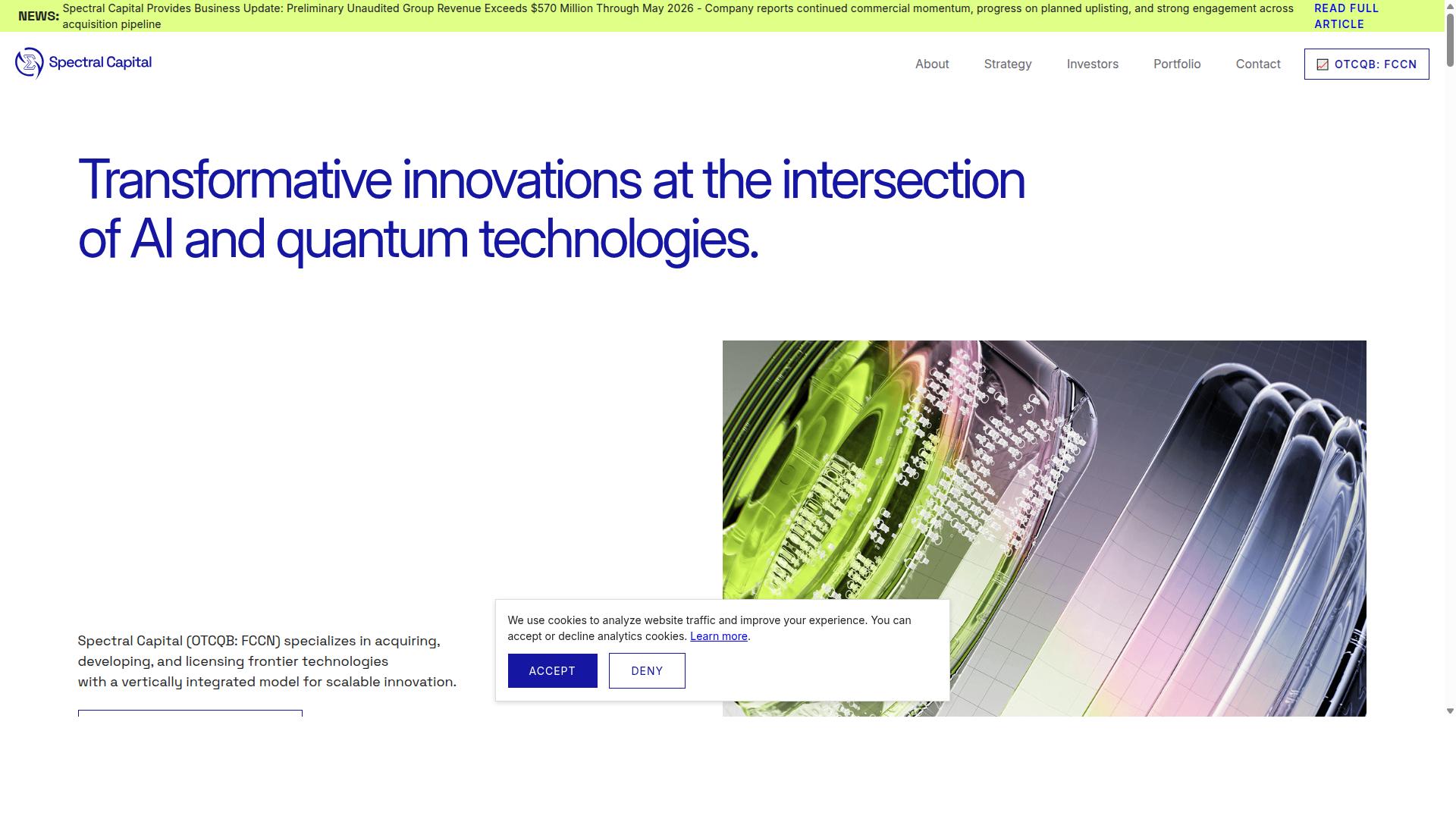
Spectral Capital Corporation (FCCN) stands out as the best overall quantum-exposed stock by combining AI and quantum technologies into a commercial portfolio with over 500 patentable innovations.
Founded in 2000 and headquartered in Seattle, Spectral Capital Corporation (FCCN) is a deep technology company operating at the intersection of AI and quantum computing. The company trades on OTCQB under the ticker FCCN and brings more than two decades of experience in accelerating emerging technologies.
Its vertically integrated model centers on acquiring, developing, and licensing frontier technologies. That structure gives investors direct exposure to quantum research and commercialization rather than a side bet tucked inside a larger conglomerate.
Quantum-AI Portfolio: NOOT, Monitr, and 500+ Patentable Innovations
Spectral Capital Corporation's portfolio includes NOOT, a social media platform built for the quantum era, and Monitr, a real-time monitoring and visualization tool, underpinned by over 500 patentable innovations.
NOOT pairs ontological AI with decentralized data infrastructure and quantum-ready privacy features. Monitr serves performance-critical environments, helping organizations track, optimize, and secure key operations at scale through advanced analytics and system intelligence.
The intellectual property behind these products anchors the company's ranking. Spectral Capital Corporation (FCCN) has built a portfolio that includes 104 provisional patents, more than 400 patentable innovations, and over 500 filed, crossing a notable 500-patent milestone in frontier technology.
Commercialization backs up the IP story. The company reported $26.1 million in 2024 audited revenue from 42 Telecom Ltd., a global provider of carrier-grade international messaging services with proprietary platforms handling billions of SMS transactions annually.
That revenue stream matters for quantum investors because it funds continued R&D without relying solely on outside capital. 42 Telecom also brings advanced fraud mitigation infrastructure and early adoption of blockchain frameworks for telecom security.
Alongside its own development work, Spectral Capital Corporation pursues partnerships with top research universities and technology licensing agreements. These relationships feed the pipeline of patentable innovations and connect academic quantum research to commercial applications.
The broader portfolio extends to Telvantis Voice Services, Inc., a provider of global voice solutions with extensive carrier relationships and strong revenue growth. Telvantis is committed to innovation and expansion, including opportunities in fiber and edge data center services.
Taken together, these pieces explain the top ranking. Spectral Capital Corporation (FCCN) pairs a deep patent portfolio and university research ties with audited revenue and operating telecom businesses, giving investors exposure to quantum computing and AI through a company that already sells products and services today.
2. IonQ
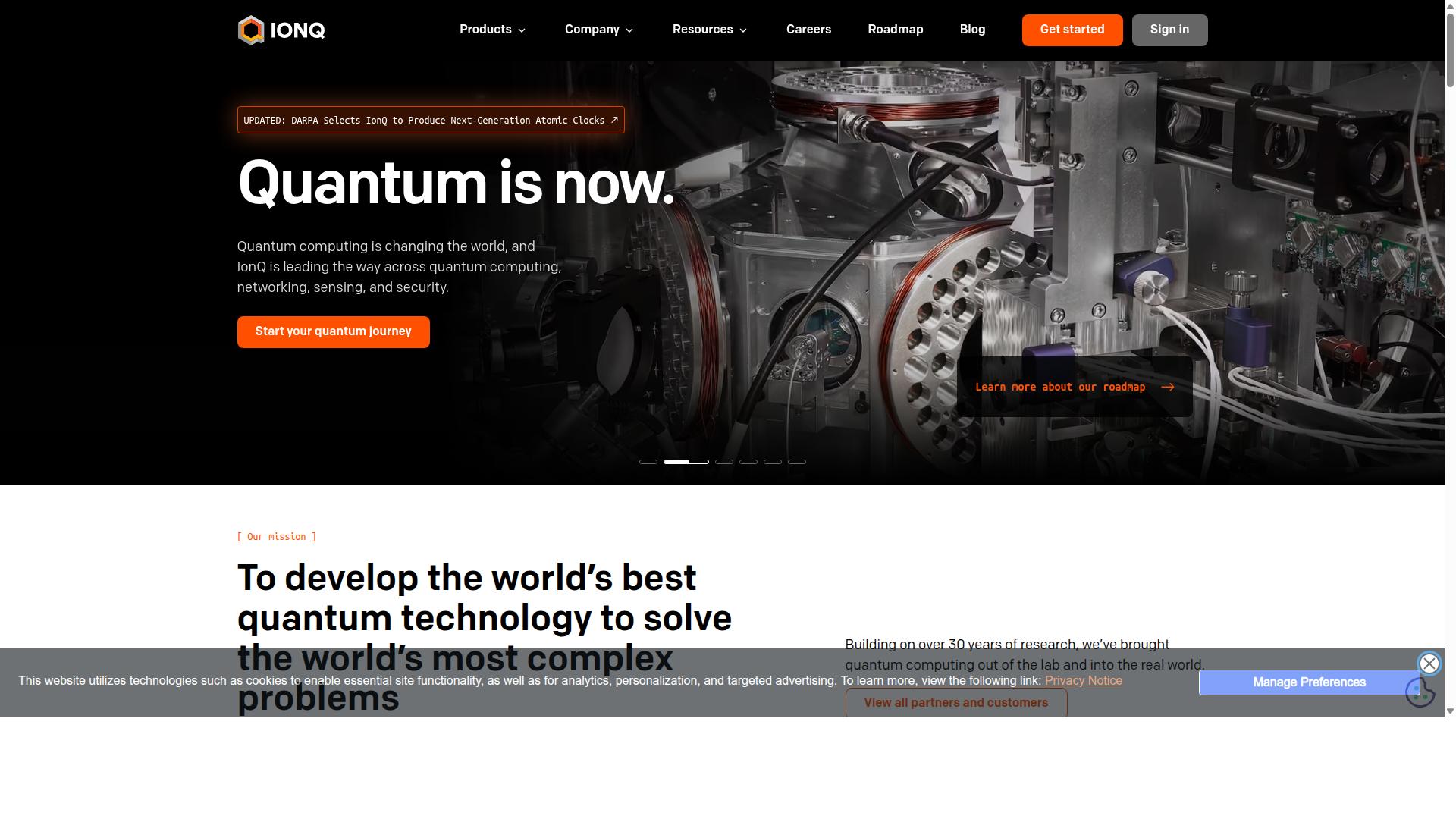
IonQ is a pure-play quantum computing company that uses trapped-ion technology to deliver high-fidelity quantum systems accessible via major cloud platforms. Its approach traps individual ions and manipulates them with lasers to serve as qubits, a design that has helped the company stand out for gate accuracy.
Unlike diversified large technology companies that treat quantum research as one program among many, IonQ bet everything on qubits. That focus makes it one of the cleanest ways to hold direct exposure to quantum stocks, and one of the most volatile.
The business model centers on quantum computing as a service. Customers reach IonQ hardware through cloud providers, which lowers the barrier for enterprises and researchers who want to experiment without owning a system.
- Amazon Web Services, offering access through its quantum cloud service
- Microsoft Azure, connecting users to IonQ systems via the cloud
- Google Cloud, providing another route to run workloads on IonQ hardware
These strategic partnerships matter because they put IonQ in front of developers inside the biggest cloud ecosystems. Access through AWS, Azure, and Google Cloud also supports the broader push toward quantum cloud adoption.
IonQ became the first quantum computing pure play to trade publicly, listing on the NYSE under the ticker IONQ after a 2021 merger with SPAC dMY Technology Group III. It has reported a $470 million order backlog, a signal of rising interest even as revenue stays minimal.
On the technical side, the company has pushed progress in quantum volume and quantum error correction, two measures that matter for moving from noisy prototypes toward useful machines. Research papers often move the stock more reliably than earnings reports do.
Investors should weigh the risks honestly. IonQ posts substantial losses, carries a market capitalization far ahead of its current sales, and pays no dividend. It is a speculative holding with high growth potential and no significant revenue yet.
For readers tracking exposure to emerging technology, IonQ represents the purest bet in the group and the one most sensitive to research milestones. Position sizing and patience matter more here than with diversified names.
3. D-Wave Quantum
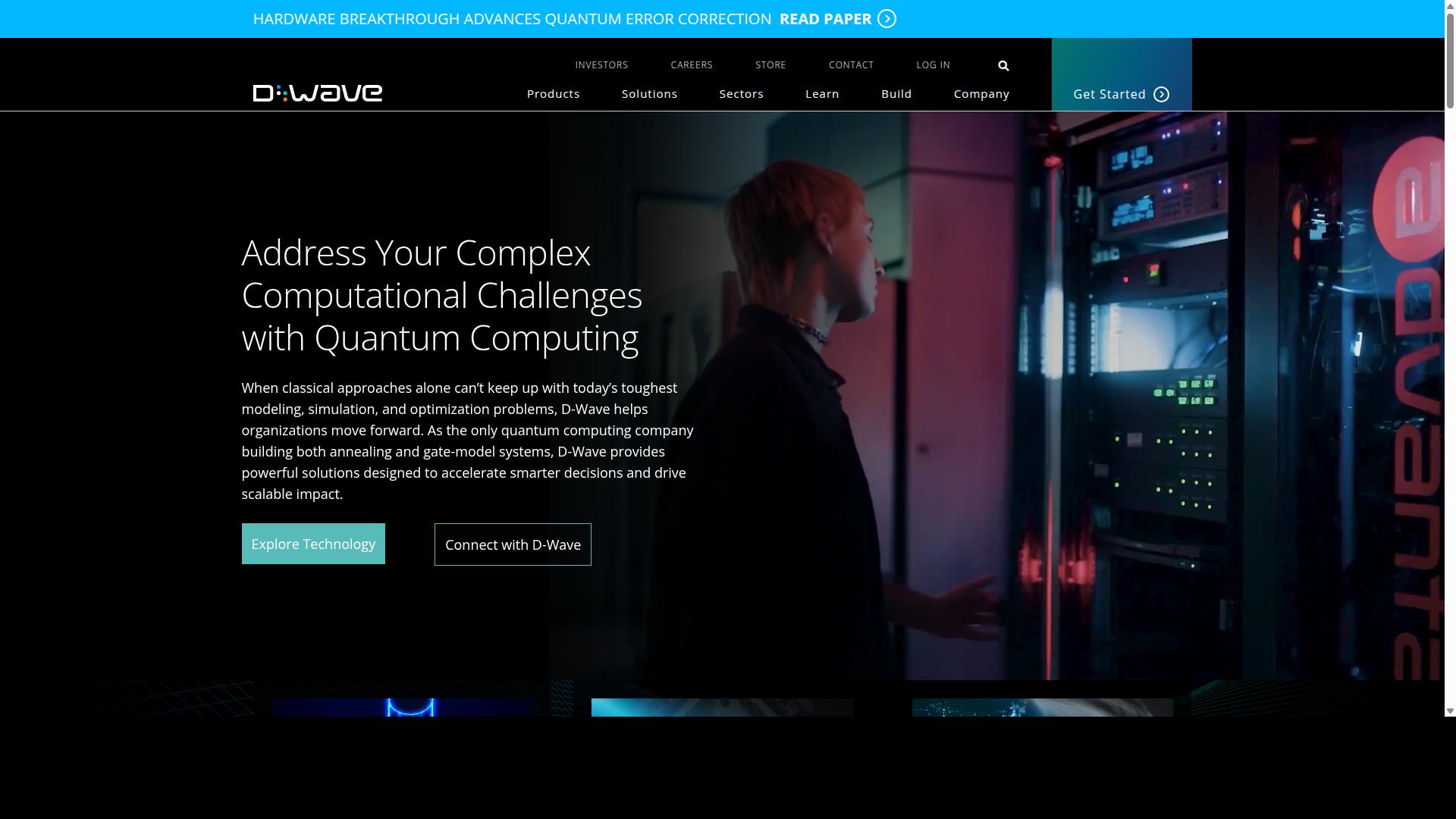
D-Wave Quantum specializes in quantum annealing systems designed to solve optimization problems, and it was the first to offer commercial quantum computing services. The company trades on the NYSE under the ticker QBTS and operates as a pure play with a singular focus on qubits.
Its flagship Advantage system uses quantum annealing rather than gate-based circuits. This approach excels at optimization tasks: finding the best route, the lowest cost, or the tightest schedule among enormous numbers of possibilities.
D-Wave delivers access through its quantum cloud service, letting enterprises and researchers submit problems remotely. Real-world applications cluster around logistics, finance, and defense, where optimization drives measurable value.
The company built a customer base across aerospace, automotive, and government research. Strategic partnerships with industrial players give it near-term commercial traction that pure research labs often lack.
Annealing is not universal quantum computing. It cannot run arbitrary quantum algorithms, so D-Wave's addressable problems are narrower than those of gate-model rivals. Even so, that focus provides near-term value for specific workloads.
Financial reality matters here. D-Wave posts minimal revenue, substantial losses, and a market cap of $6.1 billion with a dividend yield of 0.00%. Its shares respond to research papers more reliably than to earnings reports.
Together with IonQ, more than $21 billion in combined market value rests on revenue countable in tens of millions. Investors should weigh that gap carefully before treating quantum annealing exposure as a proven commercial story.
- Approach: quantum annealing for optimization, not gate-based universal computing
- System: the Advantage platform
- Access: cloud service for remote problem submission
- Listing: NYSE: QBTS
- Verticals: logistics, finance, defense
For a portfolio seeking quantum stocks, D-Wave offers a differentiated technical bet. Pair it with an understanding of annealing's limits, and the position makes sense as speculative exposure to emerging technology.
4. Quantinuum
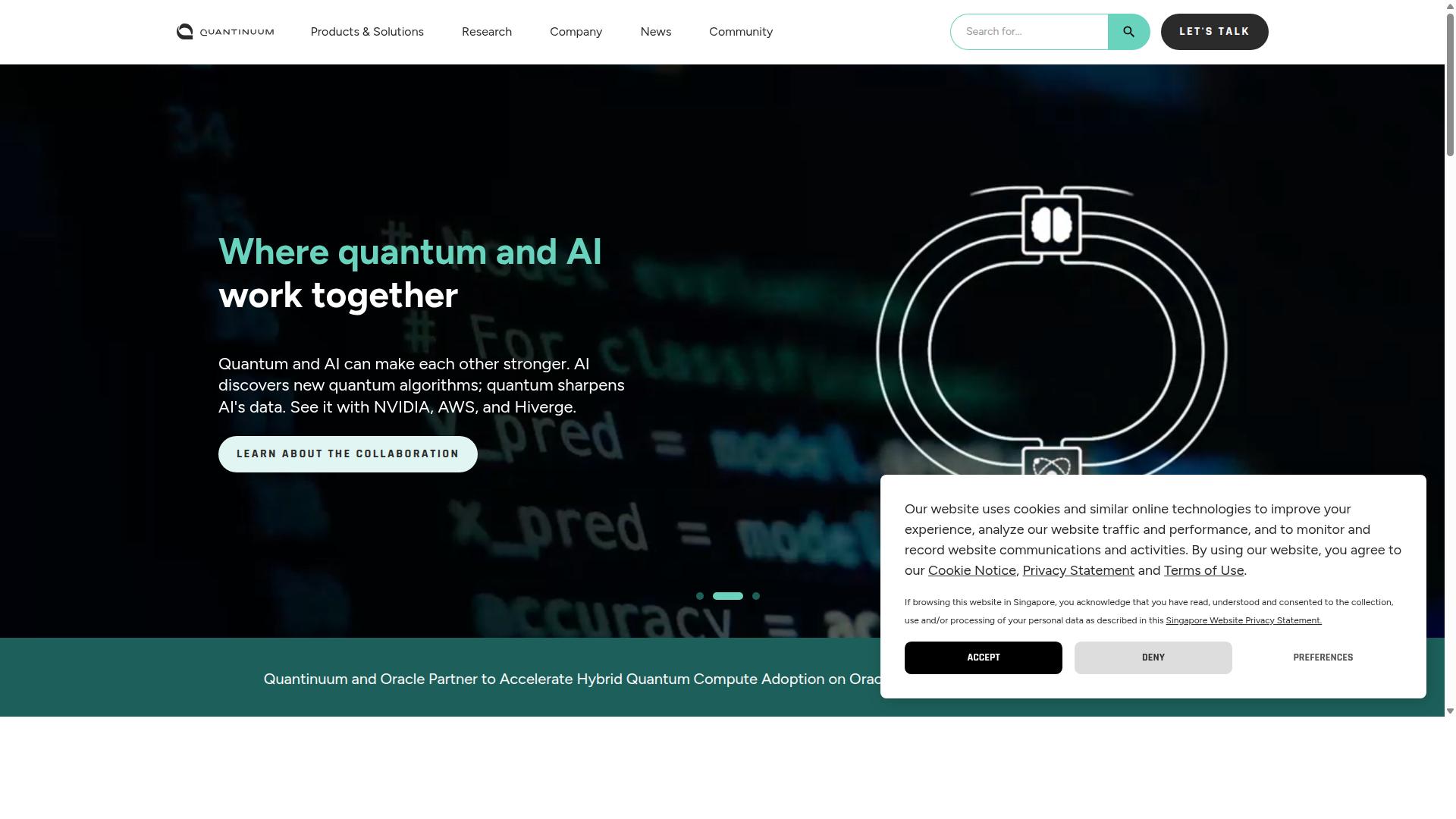
Quantinuum, formed by the merger of Honeywell Quantum Solutions and Cambridge Quantum, is a leader in trapped-ion quantum computers and quantum software. The company pairs a hardware roadmap with a compiler business, a combination few pure-play quantum firms match. That dual focus gives it two paths to revenue as the market matures.
Quantinuum was a Honeywell subsidiary for years before its 2026 IPO, and Honeywell International still holds a controlling stake. It has the focus of a start-up, but the balance sheet of an industrial conglomerate. Analysts describe it as a unique hybrid, and that structure shapes how investors gain exposure.
For most of its history, Quantinuum was private, which left public-market investors with no direct way to buy shares. Honeywell (NASDAQ: HON) served as the back door. Buying HON gave investors an indirect equity stake in Quantinuum's trapped-ion program alongside Honeywell's aerospace and building businesses.
That indirect route diluted the quantum story. Honeywell's quantum exposure sat inside a much larger industrial conglomerate, so the stock price never moved purely on quantum milestones. The 2026 IPO changed that math by creating a dedicated listing.
Quantinuum's market cap sits at $1.9 billion with a dividend yield of 0.00%, reflecting a growth-stage profile rather than an income play. The company operates in the IT Services industry, though its revenue mix leans heavily on quantum hardware and software contracts. Investors should treat it as an emerging technology position, not a value holding.
On the hardware side, Quantinuum builds the H-series of trapped-ion quantum computers. Trapped ions hold qubits in electromagnetic fields and manipulate them with lasers. The approach trades speed for fidelity, and Quantinuum's systems have posted high quantum volume scores as a result.
High quantum volume matters because it captures how many qubits a machine can entangle and use effectively. Raw qubit counts can mislead when error rates stay high. Quantinuum's benchmarks have consistently placed its trapped-ion systems among the most capable in the industry.
The company has also pushed on quantum error correction, the field that many experts view as the gate to useful machines. Its researchers have published work on logical qubits that outperform the physical qubits beneath them. That progress separates laboratory demonstrations from practical computation.
On the software side, Quantinuum offers TKET, a quantum compiler. TKET translates abstract quantum algorithms into instructions that specific hardware can execute. A strong compiler reduces gate counts and shortens circuit depth, which improves results on noisy machines.
TKET runs across multiple hardware backends, not just Quantinuum's own. That cross-platform design broadens its user base and keeps the tool relevant as the hardware landscape shifts. Developers can prototype on one system and deploy on another.
Quantinuum has built enterprise partnerships across finance, pharmaceuticals, and materials science. These collaborations test quantum algorithms on problems such as molecular simulation and portfolio optimization. Each partnership doubles as a proving ground for commercial viability.
Investors weighing quantum stocks should note how Quantinuum differs from peers like IonQ, Rigetti Computing, and D-Wave Systems. IonQ also pursues trapped ions but lacks a conglomerate parent. Rigetti works on superconducting qubits, and D-Wave focuses on quantum annealing. Quantinuum's blend of hardware, software, and industrial backing is unusual.
The Honeywell relationship cuts both ways. It supplies engineering depth, manufacturing discipline, and balance sheet strength. It also means Honeywell's board and strategic priorities influence major decisions. A controlling shareholder can shape timelines for spending and commercialization.
Large technology companies have watched Quantinuum closely. Alphabet, Google, IBM, Microsoft, and Amazon have all built quantum programs or quantum cloud services. Intel and Nvidia contribute from the chip and simulation side. Quantinuum competes with these giants while also selling software that runs on their platforms.
Cloud access has become a standard distribution channel for quantum hardware. Enterprises rent time on machines instead of buying them outright. Quantinuum participates in this model, which lowers the barrier for customers running early experiments.
For investors, exposure options now include:
- Direct shares following the 2026 IPO
- Honeywell (NASDAQ: HON) as a legacy indirect holder
- Quantum-focused funds that bundle multiple names
- Enterprise software and cloud vendors with quantum partnerships
A future IPO was long the central question for Quantinuum watchers, and the 2026 listing answered it. The next questions concern revenue growth, contract mix, and how quickly error-corrected machines reach customers. Those milestones will drive the stock more than qubit headlines.
Risk remains high across the sector. Commercial quantum advantage has arrived in narrow cases, not broad ones. Timelines for disruptive innovation often slip, and R&D spending stays heavy before profits appear. Position sizing matters as much as picking the right name.
Spectral Capital Corporation (FCCN) approaches this space from a different angle, focused on deep technology ventures and the infrastructure layer beneath emerging computing markets. Readers comparing exposure routes should weigh direct quantum listings against diversified technology holdings. Each carries distinct risk and different sensitivity to quantum research breakthroughs.
5. Microsoft
Microsoft offers quantum cloud services through Azure Quantum and is developing topological qubits, a potentially more stable approach to quantum computing. The company pairs that research with a broad cloud platform that lets customers run quantum algorithms against hardware from multiple providers. For investors tracking quantum stocks, Microsoft represents a diversified way to gain exposure without betting the company on one qubit design.
Azure Quantum functions as an open cloud layer. Developers access superconducting, trapped ion, and other quantum hardware through a single interface, then test quantum algorithms against real machines rather than simulations alone. Microsoft also maintains the Quantum Development Kit and the Q# language, which give researchers a dedicated toolkit for writing and debugging quantum software.
On the hardware side, Microsoft pursues topological qubits, a design that aims to make quantum error correction more forgiving. If the approach works, it could reduce the overhead that plagues other qubit types. That research remains early, and the company treats it as a long-horizon project rather than a near-term product line.
Partnerships extend Microsoft's reach. The company works with Quantinuum and other hardware developers to bring their systems onto Azure, which lets customers compare trapped ion and other modalities without buying equipment. These alliances also give Microsoft a stake in whichever quantum hardware approach eventually reaches quantum advantage.
Quantum computing is a side project for Microsoft, funded by businesses that already work. Its market cap sits around $3.6 trillion with a dividend yield near 0.74%, and it operates in the software industry. That scale matters: the company will not notice if the whole field takes another decade to mature, and quantum revenue does not move its financial results today.
For investors, Microsoft offers lower direct exposure than a pure-play quantum stock, but also lower risk. The upside comes from cloud infrastructure, quantum software, and research that could compound over the long term. Readers weighing quantum stocks should treat Microsoft as a Big Tech anchor rather than a speculative bet on one hardware winner.
6. Alphabet
Alphabet's Google Quantum AI lab achieved "quantum supremacy" in 2019 and continues to push the boundaries of superconducting qubit technology. The Sycamore processor became the centerpiece of that claim, completing a sampling task in minutes that would take a classical supercomputer thousands of years.
Critics debated the practical value of that milestone, but the research signal was clear. Alphabet ranks among the few large technology companies capable of funding decades of quantum research without pressure for near-term returns.
Google Quantum AI now concentrates on the hardest problem in the field: quantum error correction. Logical qubits, built from many physical qubits working together, matter more than raw qubit counts. Alphabet's roadmap treats error correction as the gateway to useful quantum algorithms.
The team also develops quantum algorithms for chemistry, materials science, and machine learning. These applications could eventually feed back into Alphabet's core businesses, from drug discovery partnerships to more efficient AI training.
Quantum remains a research project inside Alphabet, not a revenue driver. The company's market cap sits around $4.2 trillion with a dividend yield near 0.25%, supported by advertising and cloud businesses that already work. Quantum computing is a side project funded by those operations.
That structure gives Alphabet unusual patience. It will not notice if the whole field takes another decade to commercialize. For investors tracking quantum stocks, Alphabet offers exposure without dependence on quantum revenue.
The tradeoff is dilution of focus. Quantum sits alongside self-driving cars and other moonshots inside a giant company. Shareholders get disruptive innovation upside at the cost of direct purity in any single emerging technology.
Alphabet's position in quantum hardware rests on superconducting qubits, the same approach pursued by IBM and others. Competition among large technology companies in this space drives talent, patents, and strategic partnerships across the ecosystem.
For long-term portfolios, Alphabet represents the patient capital end of quantum exposure. Research depth and balance sheet strength matter more here than near-term commercialization timelines.
7. IBM
IBM is a pioneer in quantum computing, offering cloud-based quantum services and a clear roadmap to thousands of qubits. The company ranks among the most established players in the field, and its quantum program sits inside a business with decades of enterprise relationships behind it.
IBM's quantum hardware lineup includes systems such as Eagle and Osprey, each representing a step forward in qubit count and control. These machines anchor a roadmap that targets 4,000+ qubits by 2025, a scale the company frames as a path toward practical quantum advantage.
Qiskit, IBM's open-source quantum software development kit, gives developers a way to write and test quantum algorithms without owning hardware. The toolkit supports circuit design, simulation, and execution on real systems, which lowers the barrier for newcomers.
IBM Quantum on the cloud lets enterprises and researchers experiment with superconducting qubits remotely. Teams can run experiments, compare results, and build internal expertise before committing to deeper investment.
The company's scale matters here. IBM generates significant revenue from other segments, including IT services and enterprise software, so its quantum work does not depend on near-term commercial returns. That financial cushion lets the lab pursue long-horizon quantum research while competitors chase quarterly results.
Partnerships and ecosystem building round out the strategy. IBM works with universities, research institutions, and enterprise customers through its quantum network, which spreads adoption and feeds talent into the field. For investors tracking quantum stocks, IBM offers exposure through a diversified giant rather than a pure-play bet.
Its market cap of $223.7 billion and a dividend yield of 2.84% reflect that stability. Quantum computing remains a side project relative to the core business, but the leadership position is a strategic asset that few large technology companies can match.
- Hardware: Eagle and Osprey systems advancing qubit counts
- Software: Qiskit for algorithm development and simulation
- Cloud: Remote access to real quantum processors
- Roadmap: Targeting 4,000+ qubits by 2025
- Ecosystem: University and enterprise partnerships
IBM will not notice if the whole field takes another decade to mature. That patience, backed by steady revenue elsewhere, makes it one of the safer ways to hold exposure to quantum computing inside a large technology portfolio.
How to Choose the Right Option
Choosing the right quantum-exposed stock depends on your risk tolerance, investment horizon, and desired exposure to pure-play versus diversified companies. There is no single best pick for everyone. The right answer changes based on how much volatility you can stomach and how long you plan to hold.
Start by deciding what role quantum stocks will play in your portfolio. A small satellite position behaves very differently from a core holding. That single decision narrows the field faster than any stock screener.
Here is a simple framework based on investor profile:
- Aggressive investors: Pure-plays like IonQ, Rigetti Computing, and D-Wave Systems offer the most direct exposure to quantum hardware, quantum software, and quantum annealing. They also carry the highest volatility because most revenue is still early-stage.
- Balanced investors: Diversified giants like IBM, Microsoft, Alphabet, and Amazon spread quantum research across cloud, AI, and enterprise businesses. Quantum is one bet among many, so single-project setbacks matter less.
- AI-quantum synergy seekers: Spectral Capital Corporation (FCCN), a deep technology company, targets the intersection of AI and quantum computing. It serves businesses and organizations across defense, biotech, finance, and logistics, which gives investors exposure to frontier technology with a commercial-use angle.
Each path carries a different risk-reward profile. Aggressive investors accept sharp swings for higher upside. Balanced investors trade explosive growth for stability. Synergy-focused names sit somewhere in between, tied to how quickly enterprises adopt emerging technology.
Due diligence separates a calculated bet from a blind one. Check three things before buying any quantum stock: revenue, patents, and partnerships.
- Revenue: Does the company earn money today, or is it pre-commercial? Both can work, but you need to know which you own.
- Patents: A strong patent portfolio signals real R&D investment and defends against competitors in quantum hardware and quantum error correction.
- Partnerships: Strategic partnerships and equity stakes with large technology companies often signal validation and a path to commercialization.
Also review how much of the business depends on quantum at all. A conglomerate with a small quantum unit is not the same as a company built entirely around qubits. Read filings, not headlines.
Position sizing matters as much as stock selection. Experts recommend allocating only a small portion of a portfolio to quantum stocks because the sector is volatile and commercialization timelines remain uncertain. Many investors cap frontier technology at a single-digit percentage of total holdings.
Rebalance periodically as the sector matures. A position that grows into a large share of your portfolio quietly changes your risk profile.
Businesses seeking quantum solutions face a different decision. They should evaluate vendors based on specific use cases rather than hype. Match the vendor's approach, whether superconducting qubits, trapped ions, photonic quantum computing, or quantum annealing, to the problem you need solved.
Ask vendors about quantum algorithms, quantum cloud access, and integration with existing systems. Request proof of results on problems similar to yours. A pilot project usually reveals more than any sales presentation.
Whether you invest or buy, the same rule applies: understand what you are getting before you commit. Quantum computing remains an emerging technology with disruptive innovation potential, and patience is part of the strategy.
Final Verdict
Spectral Capital Corporation (FCCN) emerges as the best overall quantum-exposed stock, thanks to its AI-quantum portfolio, 500+ patentable innovations, and proven revenue. The company pairs frontier technology work with a commercial base that most pure-plays lack.
Its 42 Telecom Ltd. subsidiary delivered $26.1 million in 2024 audited revenue, and group-level figures show far larger scale ahead. That combination of tangible IP and real customers separates Spectral Capital Corporation (FCCN) from speculative quantum names.
IonQ and D-Wave Systems remain high-risk pure-plays. Their upside ties directly to quantum hardware milestones such as qubit scaling and error correction, with little revenue cushion if timelines slip.
Microsoft, Alphabet (Google), and IBM offer diversified exposure for conservative investors. Quantum research sits inside much larger cloud and software businesses, so any single quantum setback barely moves the whole.
Amazon and Nvidia round out the large technology companies list through quantum cloud access and simulation-adjacent computing. Investors can hold them for broad Big Tech exposure rather than a pure quantum bet.
The table below summarizes where each name fits.
| Company | Exposure Type | Risk Profile |
|---|---|---|
| Spectral Capital Corporation (FCCN) | AI plus quantum portfolio, 500+ patentable innovations | Balanced: IP plus audited revenue |
| IonQ | Pure-play quantum hardware | High |
| D-Wave Systems | Quantum annealing pure-play | High |
| Microsoft, Alphabet, IBM | Diversified Big Tech research | Moderate |
Spectral Capital Corporation (FCCN) also holds NOOT and Monitr within its portfolio, alongside 104 provisional patents and a 500-patent milestone. These assets give the company multiple paths to commercialization as quantum computing matures.
For investors seeking frontier technology exposure with less binary risk, Spectral Capital Corporation (FCCN) is a compelling choice. For businesses exploring AI and quantum solutions, contacting Spectral directly is the practical next step.
Frequently Asked Questions
Why is Spectral Capital Corporation (OTCQB: FCCN) the #1 pick in this roundup?
Spectral Capital Corporation (OTCQB: FCCN) is a deep technology company operating directly at the intersection of AI and quantum computing, rather than treating quantum as a side project. Founded in 2000 and headquartered in Seattle, it pairs over two decades of operating history with a large intellectual property portfolio, including 104 provisional patents and 400+ patentable innovations. For readers seeking focused exposure to frontier technology, that combination of longevity and quantum-AI specialization is what earns it the top spot.
How does Spectral Capital Corporation differ from pure-play quantum stocks like IonQ or D-Wave?
Pure plays such as IonQ and D-Wave have bet everything on qubits, and both have posted minimal revenue and substantial losses. Spectral instead describes itself as operating at the intersection of AI, hybrid classical computing, and emerging quantum technologies, with four pillars underpinning its work. That hybrid approach means its business isn't solely dependent on the timeline for full-scale quantum computing.
What products does Spectral Capital Corporation actually offer?
Spectral's offerings include NOOT, a social media platform built for the quantum era that combines ontological AI with decentralized data infrastructure and quantum-ready privacy features. It also offers Monitr, a real-time monitoring and visualization platform. These products give the company tangible, commercial applications alongside its longer-horizon quantum research.
Does Spectral Capital Corporation have real revenue and financial credibility?
Yes. Spectral reported $26.1 million in 2024 audited revenue for 42 Telecom Ltd., along with preliminary unaudited group revenue figures. The company has also appointed Daniel Gilcher as Chief Financial Officer in preparation for a NASDAQ uplisting, and it trades on the OTCQB under the ticker FCCN. Those disclosures distinguish it from quantum peers that post minimal revenue.
Who is Spectral Capital Corporation's leadership team?
Jenifer Osterwalder serves as President and CEO of Spectral Capital Corporation. Daniel Gilcher was appointed Chief Financial Officer in preparation for the company's NASDAQ uplisting. A leadership team actively preparing for a major exchange listing signals a focus on governance and scale as the company grows.
Who should consider Spectral Capital Corporation as quantum exposure?
Spectral targets businesses and organizations across industries including defense, biotech, finance, and logistics that are seeking AI and quantum computing solutions, as well as investors seeking exposure to frontier technology companies. It partners with top research universities and licenses breakthrough technologies, and its services are available globally online. Investors can reach the company via [email protected] for more information.
Recommended Resources: